Thursday, 20 September 2012

Understanding Topographic Maps

A topographic map, in simple words, is a two-dimensional representation of a portion of the three-dimensional surface of the earth. Topographic maps exist, to represent land surfaces. They are used in Geologic studies, as they show you the configuration of the earths surface. A lot of you will have topographic maps in your syllabus, when you are in high-school, so it's best to understand and learn the basics from now, so you are not confused when you have been taught about these maps. 

When first looking at a topographic map, it may appear somewhat confusing and not very useful. There are a few rules that topographic contours must obey, however, and once you understand these rules the map becomes an extremely useful and easy to use tool. So, lets begin...
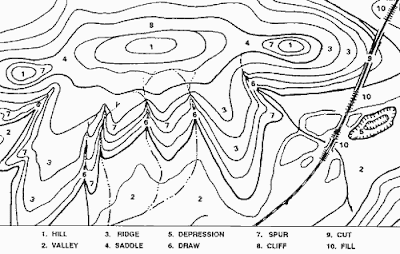


Contour Lines:

Topographic Maps are like children's drawings, if you don't understand what contour lines are. Contour lines are all over the map and understanding them are the key to understanding Topographic Maps. 
The thin brown lines snaking around a topographic map are called contour lines. All points along the same contour line are at the same elevation above sea level. Think of a contour line as a closed loop. By following a contour line on the ground, you would travel neither uphill nor downhill, eventually ending up back at your starting point. A line marked "6500," for example, means that point on the map is 6,500 feet above sea level. Be careful, however: Because contour lines are measured in regular intervals, you can find a wide elevation variation in the terrain between two contour lines.

Rules to understand Topographic Maps:


1. Contour lines never cross.

2. When a contour line crosses a river (stream) the contour line forms a "V". The "V" always points upstream. Look at the Cinder River in the diagram below and observe how the contour lines "V" toward the top of hill A. This tells you which direction the river is flowing. Remember water flows toward the lowest elevation.

3. The slope (gradient) is steepest when the contour lines are close together and gradual when they are far apart. The right side of hill A is steeper because the contour lines are much closer together.

4. Contour lines form circles or are lines that go to the edge of the map. The higher elevations on a map are found where the contour lines make smaller closed circles. See hill A on the map below.

5. A depression on a contour map is shown by contour lines with small marks pointing toward the lowest point of the depression. The first contour line with the depression marks (see hill B) and the contour line outside it have the same elevation. Based on the contour interval for this map the elevation of the first contour line with depression marks is 60 meters.

The map below shows elevations in meters and the top edge of the map points north. Use the scale below the map to measure distance on the map . This landform is an island in the ocean. 


We hope you could understand topographic maps. 


Also, you can check out our Facebook page for videos, pictures and really cool articles at www.facebook.com/SkoolShop  and follow us on twitter at @Myskoolshop


Brought to you by : www.skoolshop.com/
Come back again tomorrow!


Tuesday, 18 September 2012

Understanding Maps

The subject of geography is incomplete without understanding maps. Maps are not only really important for geography, but also very important and useful in our daily lives. Maps help us find our way if we are lost, they help us in selecting particular routes and are really important for navigation of any kind. 

For example: 
You are currently in Mumbai and have to drive to Delhi. Your friend says he knows the way, but, he makes a mistake or a wrong turn and you are lost. At this point of time, a map would be really useful, as it can help you figure out where you are and how to get to your desired destination. 
Maps, are thus really useful and an indispensable component of geography and our lives. 

Evolution of Maps:
In the earlier days, there were no views of earth as an entire planet, and barely any technology that we have today, so maps would be drawn by hand on the basis of memory and individual experiences of the land. Thus, maps of a same region could have been different. 


Today, however, with amazing technology and insights, maps are amazingly accurate and precise and can give exact distances, numbers and figures. 


Understanding Maps
Let us begin, on how to start understanding maps and its components:

1) The Key
Maps are drawn to represent varieties of information such as parks, rail roads, gas stations, camping grounds etc. The objects on the map are not written, but are represented as symbols. Understanding these symbols are important in understanding maps. To show what the symbols portray, we have a key or a legend which states what each symbol depicts. 


2) Scale
You've usually seen a drawn to scale statement in maps near the key or legend. You should always remember that maps are a visual representation of a much larger area of land. Maps are scaled down so it is possible to fit on to the screen or paper, and every part of the map is scaled down by the same amount. 
There are three kinds of scales used in maps:

a) Graphic or Bar scale:
A Graphic Scale depicts scale using a line, with separations marked by smaller intersecting lines, similar to a ruler. One side of the scale represents the distance on the map, while the other side represents the true distances of objects in real life. By measuring the distance between two objects on a map and then referring to the graphic scale, it is easy to calculate the actual distance between those same items.


b) Verbal Method:
The verbal method of depicting scale simply uses words to describe the ratio between the map's scale and the real world. For example, a map might say something like, “one inch equals one hundred and fifty miles.” Calculating scale on a map using the verbal method is easy. Simply measure the distance on the map and then follow the verbal directions to calculate the actual distance.


c) Fractional or ratio method:
The fractional method for portraying the scale of a map uses a representative fraction to describe the ratio between the map and the real world. This can be shown as 1:50,000 or 1/50,000. In this example, 1 unit of distance on the map represents 50,000 of the same units of distance in the real world. This means that 1 inch on the map represents 50,000 inches in the real world, 1 foot on the map represents 50,000 feet on the map, and so forth.

The key and the legend should help you in understanding the basic layout of the map. 

3) Calculating Distances:
Find the scale for the map you're going to use - it might be a ruler-looking bar scale or a written scale, in words or numbers.
Use a ruler to measure the distance between the two places. If the line is quite curved, use a string to determine the distance and then measure the string.
If the scale is a representative fraction (and looks like 1/100,000 or 1:100,000), multiply the distance of the ruler by the denominator, giving distance in the ruler units.
If the scale is a word statement (i.e. "One centimeter equals one kilometer") then determine the distance.
For a graphic scale, you'll need to measure the graphic and divide the scale into the measured units on the ruler.
Convert your units of measurement into the most convenient units for you (i.e. convert 63,360 inches to one mile)

This should help you with the basics about understanding maps. Come back tomorrow, for help in topographic maps. 


Also, you can check out our Facebook page for videos, pictures and really cool articles at www.facebook.com/SkoolShop  and follow us on twitter at @Myskoolshop


Brought to you by : www.skoolshop.com/
Come back again tomorrow!
 

Monday, 17 September 2012

Geography: A study of the World


If you love studying different regions and the climate, exploring the unknown and understanding the known places on this planet, then you love geography. Geography is the study of the planet we live on, and it involves science, maths and much more. Contrary to belief there are a wide range of careers for geography majors, which we will discuss in detail a little later in the week. Today we'll learn about what geography is, and why you should study it in school. 


What is geography? 
Geography is, first and foremost a science,which studies the lands, the features of the lands, the inhabitants and the phenomenon of the earth. Briefly speaking, Geography can be subdivided into two main categories, Physical Geography and Human Geography.

Physical Geography: 
Is basically an earth science, that deals with climate, oceanography, glaciology and various other earthly phenomena. 

Human Geography:
Is a branch of geography that focuses on the study of patterns and processes that shape the human society. It encompasses the human, cultural, economic and social aspects. It deals with things like Geo-politics, Transportation Geography, Demography etc.

This a a very basic definition of geography, for a detailed study you can check out: http://en.wikipedia.org/wiki/Geography


Why Study Geography?
Geography is a vast field and there are various reasons as to why we should study this really amazing and interesting subject. Some of these reasons are:


Understanding the Planet:
Studying geography can give an individual valuable insight into our planet and why things happen. It helps in understanding various natural phenomena and the power of mother earth. Those who study geography are well-positioned to comprehend and explain global political issues that occur between countries, cultures, cities and their hinterlands, and between regions within countries.  

Understanding different Regions:
Those who study geography, learn the difference between the different regions of the world. Some geographers, devote their lives to studying and researching a specific region or country in the world, and they research a host of different things like, food habits, consumption patterns, languages, research etc. Researchers in geographic hot-spots find a host of career opportunities. 

Being a Global Citizen:
In addition to knowing about our planet and its people, those who choose to study geography will learn to think critically, research, and communicate their thoughts through writing and other means of communication independently. They will thus have skills that are valued in all careers.

Career Opportunities: 
Studying geography as a major has tremendous scope and a lot of career opportunities, which pay really well. We'll speak about careers in detail later on in the week as mentioned earlier.


These are just some of the reason why geography is so important. We hope you liked today's article and come back tomorrow for more on studying geography and tips to keep it interesting. 


Also, you can check out our Facebook page for videos, pictures and really cool articles at www.facebook.com/SkoolShop  and follow us on twitter at @Myskoolshop


Brought to you by : www.skoolshop.com/
Come back again tomorrow!


Saturday, 15 September 2012

Careers in History

If you've seen the Indiana Jones series, you definitely know there are some pretty awesome careers in the field of history!

Although it is not very conventional to opt for a career in history and liberal arts, there are tremendous opportunities if you decide to take it up as a career. Historians, archaeologists and researchers earn tremendous amounts of money doing what they love. 
If you really are interested and love history, then here are some of the amazing things you could do with your life: 

Archaeologist


If you want to dig up old civilizations, decipher ancient codes and study about our ancestors, then archaeology is the field for you. Its an exciting field and if you really do love history, you will enjoy working as an archaeologist.

Museum Curators


If you love ancient artifacts and treasures, beautiful buildings and architecture, a museum curator is a really cool profession to have. It's a profession you usually get just after you have graduated, so you can have a practical learning experience. 

Careers in Law


Due to their solid foundation in research and analysis, history graduates often pursue a career in law, especially if their degree is combined with political history or science. 

Journalism


History graduates have a lot of knowledge and good communication skills, so they are often highly ranked in the field of journalism. 

Teacher


There is a lot of demand for experts in history for teaching jobs and so becoming an expert history professor is a very lucrative career path. 


These are some of the best professions in the field of history if you decide to major in it. We know you are still at school, but this is just so you know that there are careers in history as well!

Thank you and come back next week. 


Also, you can check out our Facebook page for videos, pictures and really cool articles at www.facebook.com/SkoolShop  and follow us on twitter at @Myskoolshop


Brought to you by : www.skoolshop.com/
Come back again tomorrow!

Friday, 14 September 2012

History: An Act through time

We've spoken about History being a series of amazing stories, and about some inspirational movies on historical events. These are some nice ways to learn history while having some fun, and that's what we wish to share with you'll. 

Today, we'll talk about learning history while acting! Since history has so many events and people, its possible for the entire class to participate in different plays about different events. This could be a lot of fun and you get to learn a lot as well. You'll be working with your friends and having a lot of fun looking at others act, as well as participating in one. 

What to do:
Just make groups of four, five or six, depending on how many people in your class. Pick an event, any event which you'll like as a group and which is there in your syllabus. Choose different characters, as per your likes and preferences and begin with the rehearsals. Try to engage the class, with witty lines and a good story. 

Here is an example:
Lets say, you choose the Salt March or Salt Satyagraha or the Dandi March, led by Mahatma Gandhi. 

The Salt March, also known as the Salt Satyagraha began with the Dandi March on March 12, 1930, and was an important part of the Indian independence movement. It was a direct action campaign of tax resistance and nonviolent protest against the British salt monopoly in colonial India, and triggered the wider Civil Disobedience Movement. This was the most significant organized challenge to British authority since the Non-cooperation movement of 1920–22, and directly followed the Purna Swaraj declaration of independence by the Indian National Congress on January 26, 1930. Mohandas Karamchand Gandhi (commonly called Mahatma Gandhi) led the Dandi march from his base, Sabarmati Ashram near Ahmedabad, to the sea coast near the village of Dandi.


So, you could choose roles, from Gandhiji, his followers, the guards and Lord Irwin. You can act about the march and the impact that it had on India, with these various characters and events. 
This way, you and your classmates will learn about the march. 

Another group can act as the fascist leaders, Hitler and Mussolini, and maybe another group as the Pearl Harbor incident. This way, you get to learn about all the different events in a really fun and interactive manner. 

Try this out with the class, speak to your teacher if it's possible, it would be an amazing experience for all students in the school. We hope you implement this and it helps you making history lessons more interesting. 


Also, you can check out our Facebook page for videos, pictures and really cool articles at www.facebook.com/SkoolShop  and follow us on twitter at @Myskoolshop


Brought to you by : www.skoolshop.com/
Come back again tomorrow!


Thursday, 13 September 2012

Watch Movies and Learn History!!!

The events of the past have often fascinated creators of movies, and there are some of the most amazing movies based on historic events. These movies can not only be a great source of entertainment, but also a source of knowledge. You can learn about great people of the past with some amazing movies and documentaries. 

Today we will give you, some of the best Hindi and English movies based on historic characters and events, along with a brief description, to help you learn history in a really fun and awesome way!


We should learn about the heroes of the country and the amazing people who got us freedom. Some Hindi movies have really done these freedom fighters justice. 
These are:


Rang De Basanti 


If you have not seen this movie, please WATCH IT!! Even if you have, you can watch it again. It is one of the most brilliant movies in Hindi cinema history and teaches us about the virtues of the freedom fighters like Bhagat Singh, Chandrashekhar Azad and their contemporaries. 


The Legend of Bhagat Singh


The legend of Bhagat Singh is one of the finest movies of Indian film history.The film shows the lifetime of great freedom fighter Bhagat Singh.The film depicts his life,his struggle and his determination brillantly..The film not only shows the freedom fighter's struggle,but also his ideologies and his idea of a progressive nation and how he moved the entire nation.


Mangal Pandey - The Rising


Based on the life and times of Mangal Pandey, 1857: The Rising is a film about the leader of the 1857 mutiny and his fight against the British rule.


These were some of the brilliant Hindi movies on Indian history, there are some amazing movies about the world's history too. Some of the most spectacular ones are: 

Schindler's List


One of the greatest movies of all time, it showcases how the Jews were treated by the Nazi's. 
Set in Poland during World War II, Oskar Schindler gradually becomes concerned for his Jewish workforce after witnessing their persecution by the Nazis. This movie is a must watch for everyone, it's simply brilliant. 


The Pianist


The Pianist is the true story of Wladyslaw Szpilman, at the time Poland's most acclaimed pianist whose life is transformed during the Nazi occupation of Warsaw beginning in 1939. The film spans several years and maps his many personal trials in addition to providing the perspectives of his family, rebel factions and sympathizers.


Gandhi


Here indeed is one of the great films of the 20th Century about one of the greatest men of the 20th Century. Ben Kingsley's interpretation of the Mahatma must go down in history as one of the most perfect cinema rĂ´les ever carried out. Throughout the long film you forget you are watching an actor playing the part of a great man in history: you are watching the real Gandhi. A gigantic performance indeed. Richard Attenborough's patient and perfect directing added all the superlatives possible to make a crowning achievement, transporting biographic films into another dimension.


These are some inspirational movies, through which we can learn history in a much more personalized and better way. These movies have captured the essence of those times really well, and we can actually see characters like Gandhi, Oskar Schindler and Bhagat Singh come to life with some brilliant performances. Although movies cannot replace your books, when you do come across these names in your text book, your mind will already know much more than what the book has to offer. 

We hope these movies can help you, come back again tomorrow. 


Also, you can check out our Facebook page for videos, pictures and really cool articles at www.facebook.com/SkoolShop  and follow us on twitter at @Myskoolshop


Brought to you by : www.skoolshop.com/
Come back again tomorrow!


Wednesday, 12 September 2012

History: The Greatest stories of All Time

History is a fascinating subject, with unimaginable events being haven taken place. Students find history boring whilst studying, however history can be amazingly fun, if learnt with an open mind and the right way.
We, at skoolshop, want you to be interested in history, as we live in a country, rich in stories and successes and everyone should know these amazing tales.


Mahatma Gandhi's nickname was Moniya in school. He was only 13 years old when he married his wife, Kasturba Gandhi and lived in South Africa between 1893 and 1914 where he practised law.
While studying in England, Gandhi tried learning dancing and playing the violin to try and live more like an Englishman, but later gave it up for a simple living.
Somehow I find this more interesting than simply reciting the facts of Gandhi's protests. I imagine you do, too.
 
Ken Burns, award-winning producer of PBS series on the Civil War and other topics, has said that the key to making history interesting is to engage the emotions. If we can find some personal, moving connection with history, we will want to learn more.
The last five letters of the word explain it: history is a story. We all love stories, and we relate better to stories than to a listing of facts, dates, and wars. History is our story. It is the shoulders on which we stand to see farther in our own day. The story of human beings, of people who have courageously become immigrants, used their God-given abilities to produce great inventions, and given their lives in a noble cause, is not boring.
Here are some suggestions on how to make your study of history come alive.
  1. Don't depend on textbooks. Textbooks try to organize and arrange the material for the convenience of the teacher, not necessarily for the enjoyment of the student.
     
  2. It is helpful to have some overall framework in which to place people, events, and trends; but I encourage you to find a source that is a good narrative of the story of history and not simply an outline of facts. Supplement this with real books, living books, that make the story personal.

  3. Emphasize on individuals. World War II to me is not just a big war that started with Germany and Japan being aggressive. People, familymen, fathers, served in World War II. Many of them landed in northern France the day after D-DAY. They endured the battle of the Bulge and enemy bombings. Many of them survived and had children and good lives. Read about these amazing stories, there are enough autobiographies and biographies out there. Make history personal.

  4. Come back tomorrow for a really fun activity in class which will make history your favorite subject!!


    Also, you can check out our Facebook page for videos, pictures and really cool articles at www.facebook.com/SkoolShop  and follow us on twitter at @Myskoolshop

    Brought to you by : www.skoolshop.com/


    Come back again tomorrow!